AHS Procedure
Works Operating Procedure
Unmarked Specified Aliphatic Hydrocarbon Solvents
Background
Hulamin Operations (Pty) Ltd (Hulamin) purchases hydrocarbon fluids formulated to specific standards required for use as a cold mill rolling oil in the manufacturing of semi-fabricated rolled aluminium products. Two grades of rolling oils (Somentor 32 and Somentor 34), particularly suited to the needs of Hulamin at its Pietermaritzburg site, are used in operations. The imported oils meet the specifications of Specialized Aliphatic Hydrocarbon Solvents (AHS) as defined in Additional Note 1(ij) of Schedule 1 Part 1 to the Customs and Excise Act.
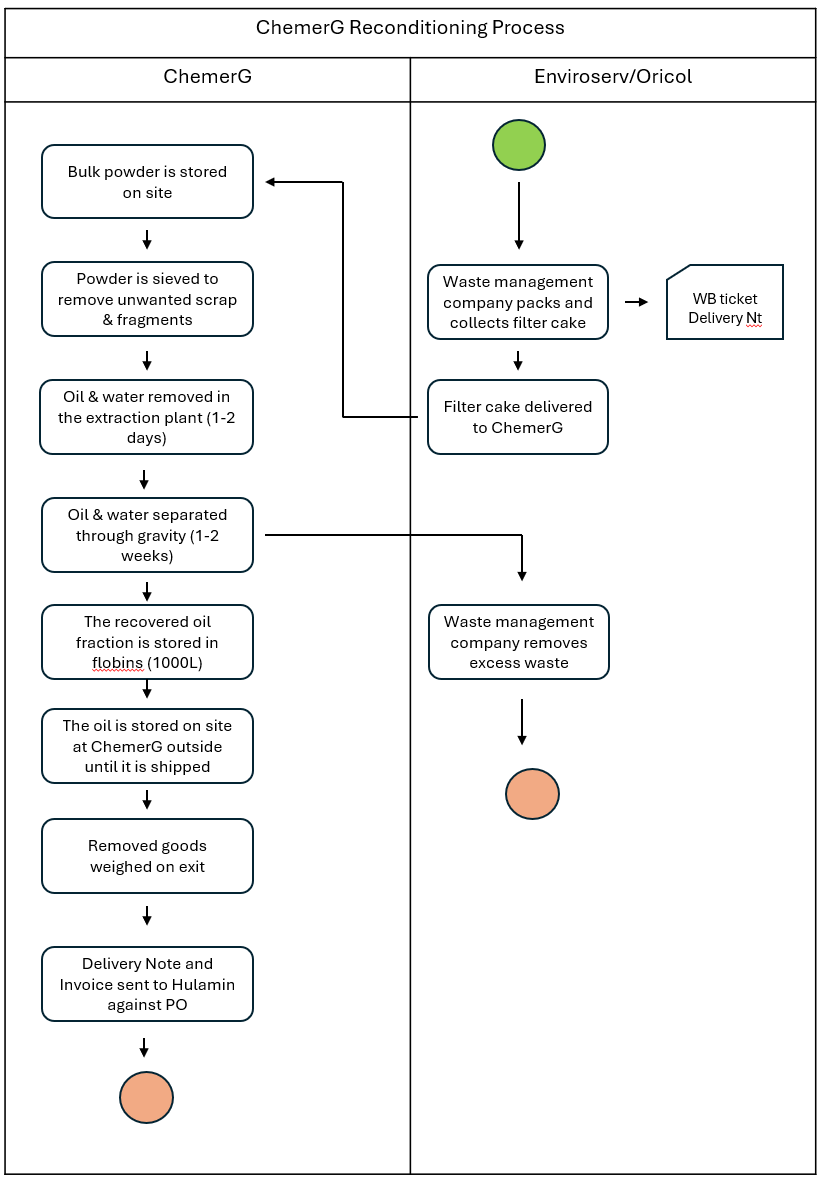
During the routine manufacturing process the rolling oil becomes contaminated and is constantly passed through a filter medium resulting in a non-liquid “filter cake” material containing AHS.
To reduce waste, Hulamin embarked on a project to recondition the filter cake that would have otherwise been disposed of in a landfill. In collaboration with ChemerG (Pty) Ltd (“ChemerG), Hulamin developed a process to recover AHS from the filter cake. In 2025, ChemerG applied for a Customs and Excise manufacturing warehouse (VM) license for the manufacture and supply of fuel levy goods as contemplated in Rule 19A4.01(b)(i).
Hulamin will supply ChemerG with feedstock (filter cake in bulk bags) that is not classified as AHS. These materials will be used by ChemerG to manufacture AHS. After this process is completed, ChemerG will supply drummed AHS to Hulamin. ChemerG does not buy the filter cake from Hulamin or sell the AHS to Hulamin and Hulamin retains ownership of the goods throughout the process.
Manufacture of Fuel Levy goods
“Manufacture”, in terms of Section 1 of the Customs Act, includes any process in the manufacture of, recovery of, or conversion of any goods into excisable goods, fuel levy goods or RAF levy goods.
In terms of Section 44 of the Customs Act, fuel levy goods are deemed to have been manufactured at the stage in the manufacturing process when the goods have acquired the essential characteristics or are capable of use as such fuel levy goods. Liability for duty commences when fuel levy goods are deemed to have been manufactured and these goods are thereby subject to controls in terms of Section 19A and the Rules to the Customs Act.
Fuel levy goods must be manufactured in a licensed customs and excise manufacturing warehouse. Rule 19A4.01(b) to the Customs Act provides that a customs and excise warehouse for the manufacture or storage of fuel levy goods may be licensed for the purpose of manufacturing a range of products which include fuel levy goods by the conversion of crude oil, coal, gas, or any other source of hydrocarbon.
Liability for duty
Whenever fuel levy goods are removed from a customs and excise manufacturing warehouse for home consumption in South Africa such goods must be entered for payment of duty and are subject to the documentary requirements and compliance provisions for due entry for home consumption of fuel levy goods. The manufacturer, owner, seller, or purchaser of these goods are liable for the duty on such goods. This liability continues until the goods have been duly declared to SARS and the duty has been paid.
Where manufactured unmarked specified aliphatic hydrocarbon solvents are not delt with in compliance with the act and sold to and used by an appropriately registered / permitted / licensed party the excise duty, fuel levy, RAF, and VAT (where applicable) becomes payable.
Any person dealing in excisable goods or fuel levy goods or having such goods entered in their books must be able to produce proof of where the goods were obtained, the place where the duty due thereon was paid, the date of payment, and the particulars of the entry for home consumption.
In terms of Section 44 (11), liability for any underpayment of duty on any goods will be for a period of two years from the date of acceptance of a bill of entry by SARS.
Reconditioning process
Legislative framework
- Customs and Excise Act - SARS
- International Trade Administration Act – ITAC
- Customs tariff investigations
- Trade remedies
- Import and export control
- Permits
Supplementary information
- SARS website
- SARS policies and guidelines
Future Developments
- Customs Control Act
- Customs Duty Act
Primary legislation
- Customs and Excise Act
- Schedules to the Customs and Excise Act
- Schedule 1 Part 1
- Harmonized Commodity Description and Coding System
- World Customs Organisation
- Schedule 1 Part 2A
- Excise duty
- Schedule 1 Part 5A
- Fuel Levy
- Schedule 1 Part 5B
- Road Accident Fund
- Schedule 1 Part 1
- Schedule 6: Refunds and Rebates of Excise Duties, Fuel Levy and Environmental Levy
- Schedule 8: Licenses
Secondary legislation
- Rules to the Customs and Excise Act
Key provisions
- Customs and excise warehouses in which excisable or fuel levy goods are manufactured or stored (Section 19A)
- Tariff classification (Section 40)
- Schedule 1 Part 1
- Rules of classification
- Valuation
- Transaction value
- Special procedures (Section 40)
- Warehousing
- Rebate use
- Other
- Entry of goods and time of entry (Section 38)
- Period available to enter goods
- Validity of entries (Section 40)
- Description/specification of the goods
- Tariff heading
- Valuation
- Circumstances of importation/exportation
- Voucher of Correction (VOC)
- Penal provisions
- Non-declaration
- Tariff classification
- Valuation
- Administrative errors
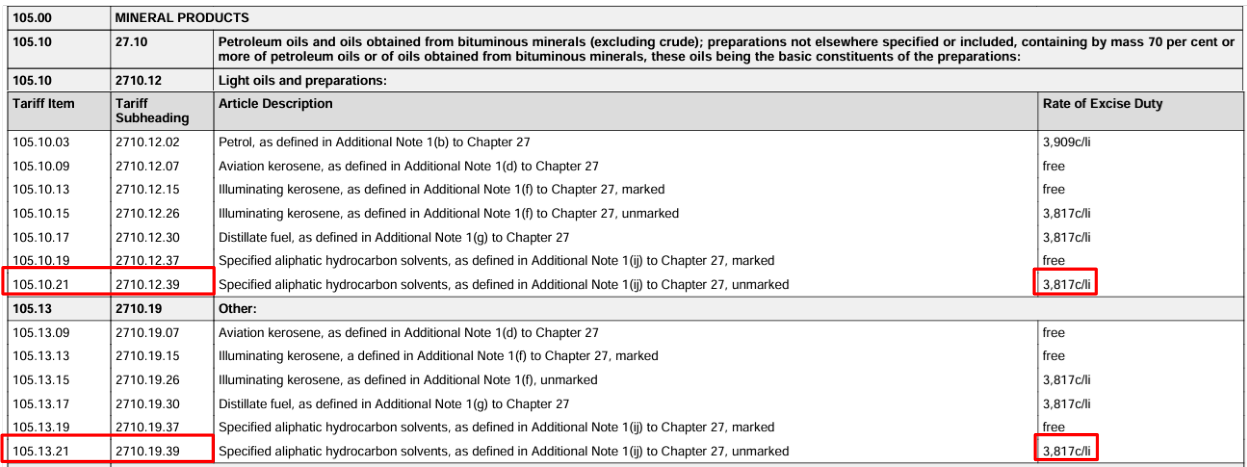
Schedule 1 Part 2A – excerpt for tariff heading 2710.12 and 2710.19
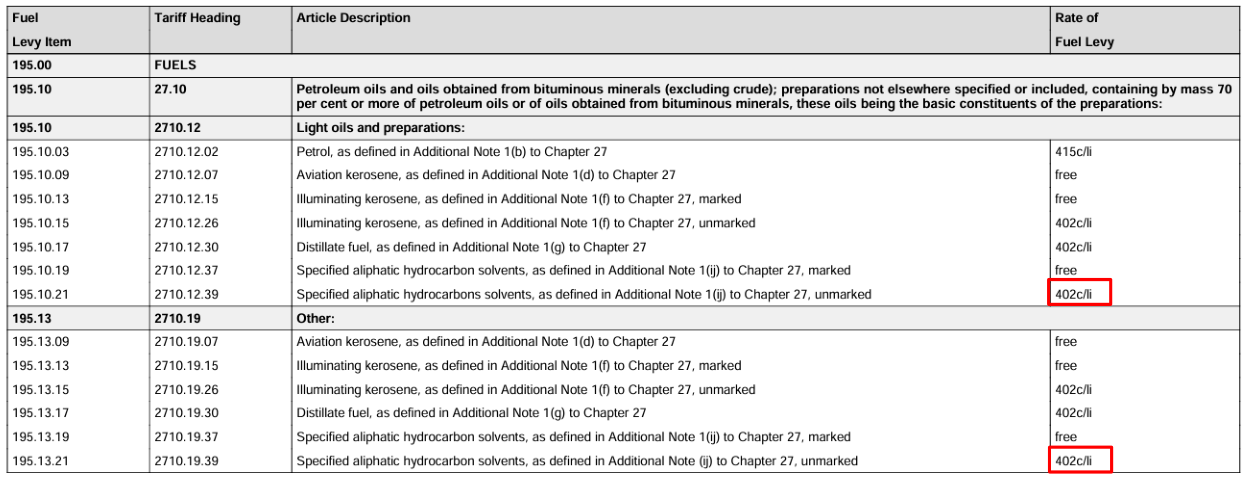
Schedule 1 Part 5A – excerpt for tariff heading 2710.12 and 2710.19
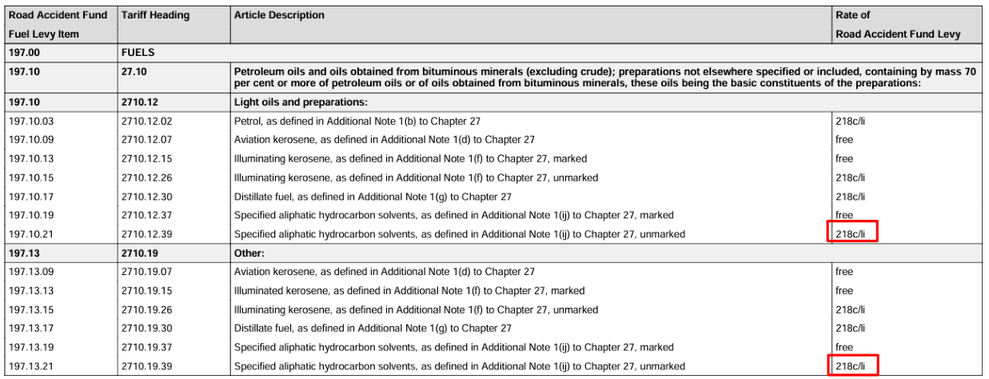
Schedule 1 Part 5B – excerpt for tariff heading 2710.12 and 2710.19
Schedule 6 – excerpt for Part 3 rebates and refunds of fuel levy and road accident fund levy 671.01
https://www.sars.gov.za/wp-content/uploads/Legal/SCEA1964/Legal-LPrim-CE-Sch6-Schedule-No-6.pdf

Movement of goods
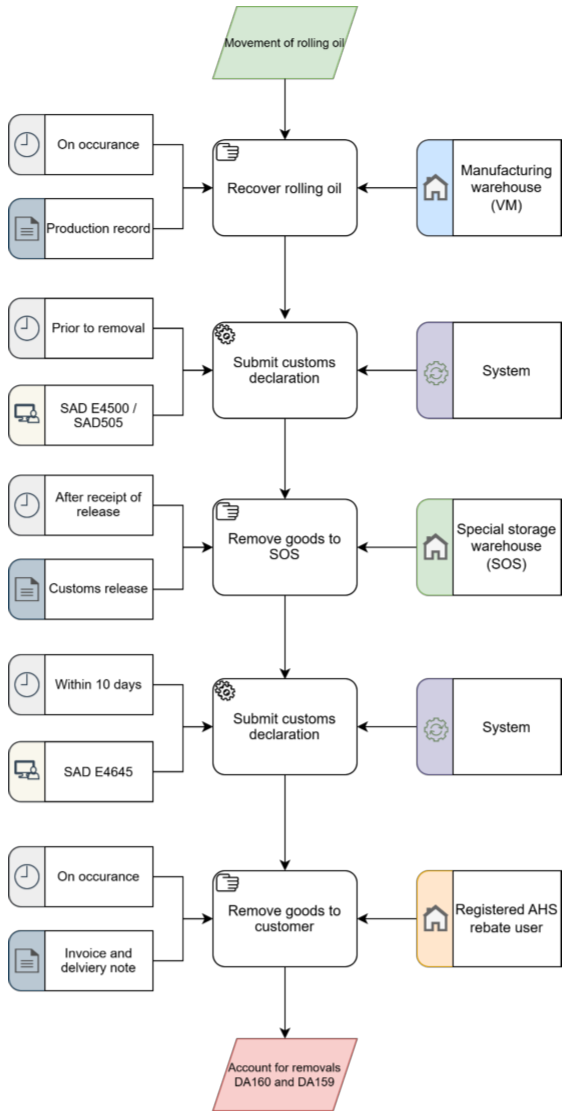
Transport requirements – Remover of Goods in Bond (ROG)
Goods that must be transported by an ROG
- Goods are entered on any prescribed form in terms of any item or Note of Schedule No. 6 for delivery to a rebate user;
- Goods contemplated in the rules for section 19A and are removed by road in terms of the rules for section 19A.
Exemptions from the removal of goods by a ROG
- The licensee of any premises, including any customs and excise warehouse licensed under this Act, using own transport.
- Any goods entered under rebate of duty on a prescribed form in terms of any item of Schedule No. 6 delivered to a registered rebate user at the premises of the licensee of the customs and excise warehouse from which such goods are supplied.
Customs declaration procedure
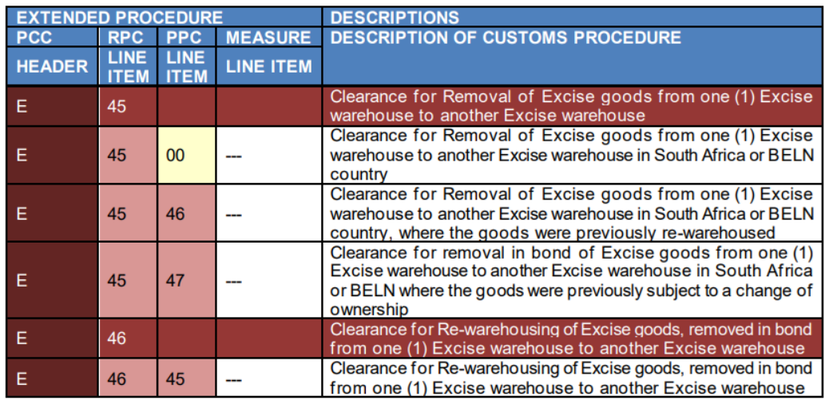
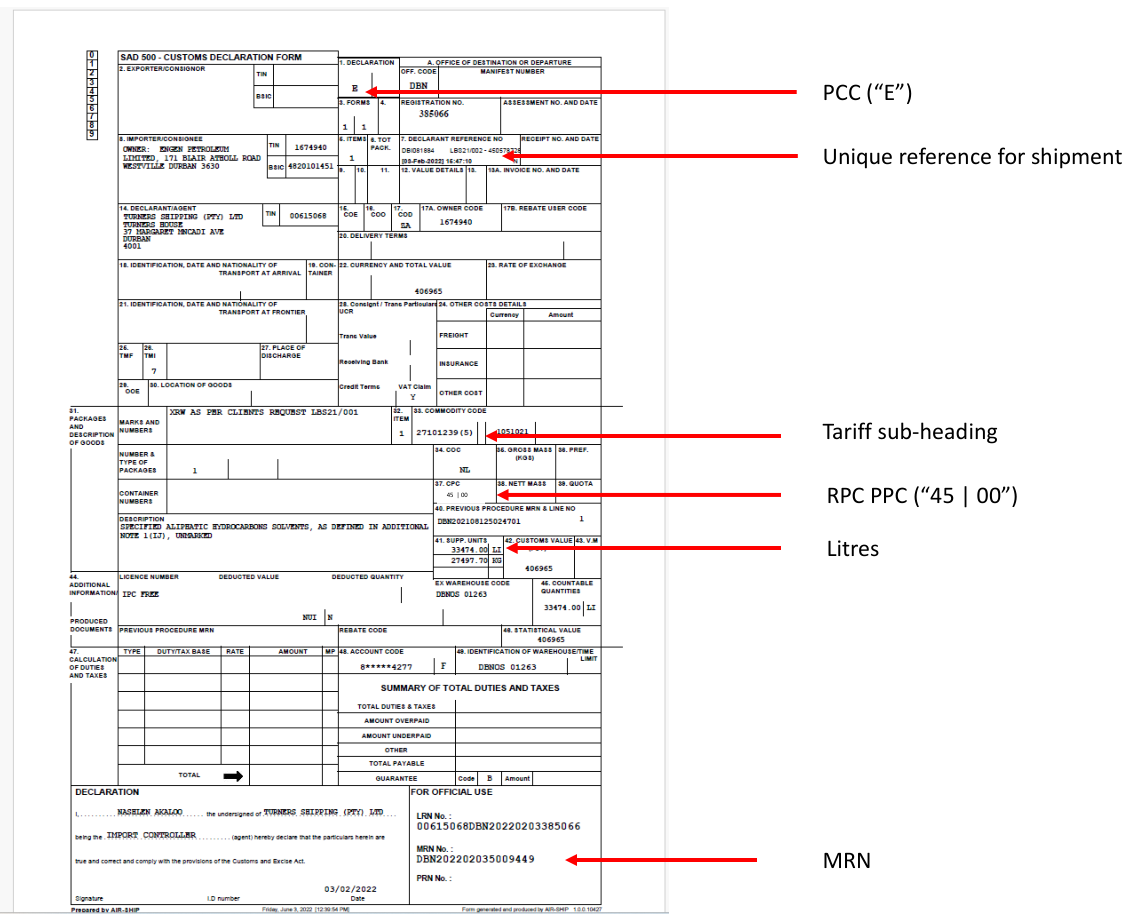
For movements between customs and excise warehouses (the VM to SOS movement in this scenario), industry practise is to use the E4500 procedure for removals and the E4645 procedure for receipt / re-warehousing).
Document requirements
The following documents should be kept for movements between warehouses and to customers that are rebate users of AHS.
| Documents | Description |
|---|---|
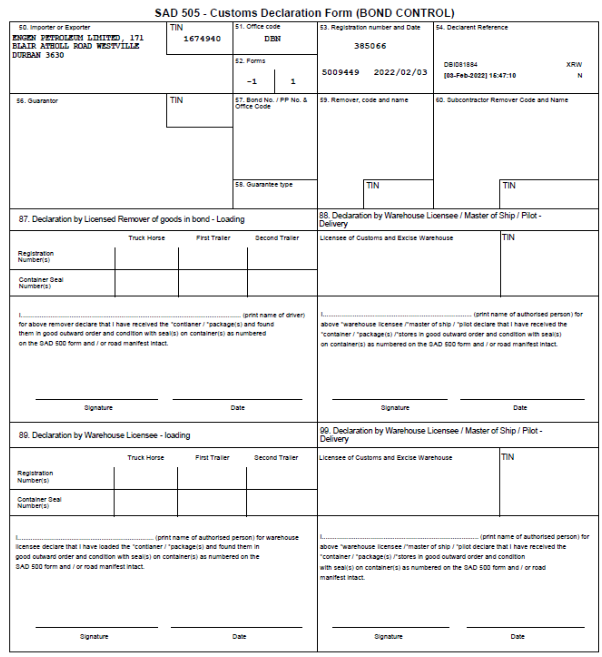
| Customs declaration SAD500 / SAD505 / SAD507 | A copy of the VM to SOS declaration. Declarations must reflect the LRN and MRN and the particulars must match the supporting documents (e.g., invoice). Confirm the correct values, references, tariff, and CPC are present on the documentation. |
| Customs declaration (Voucher of Correction) | If applicable, copies of any amended (current and previous) declarations (and the corresponding releases) must be included together with the original declaration. |
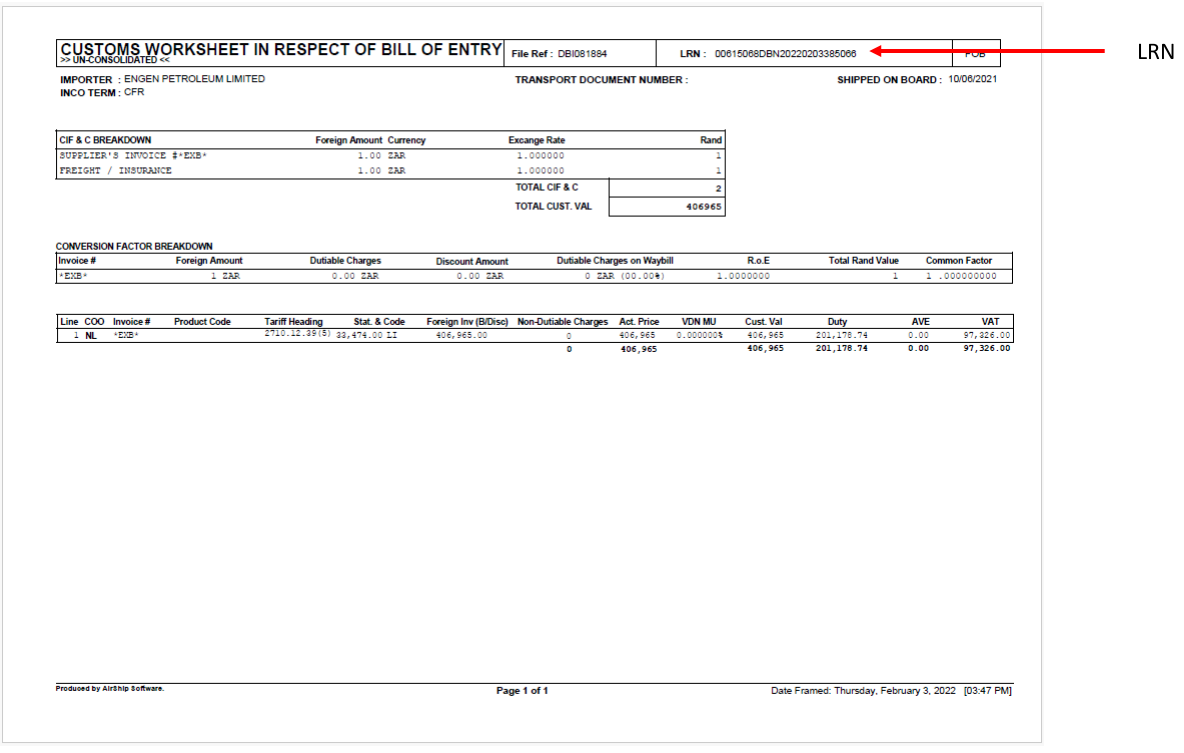
| Customs worksheet | Confirm the correct worksheet and the value, origin, and rate of exchange has been applied. |
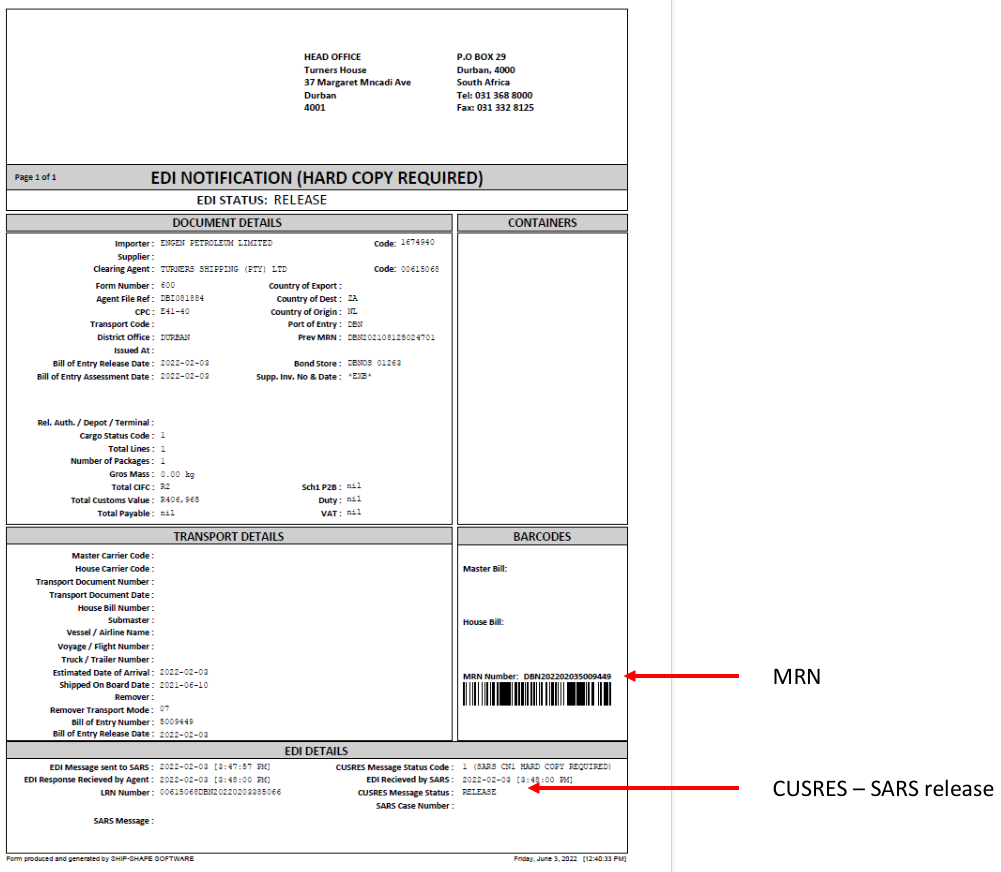
| EDI notification | Confirm correct SARS release for the customs declaration and that it matches customs declarations. Ensure the release date for the ZIB and ZRW are within the timelines. |
| Transport document | Road freight manifest document confirming what was loaded/accepted onto the truck. |
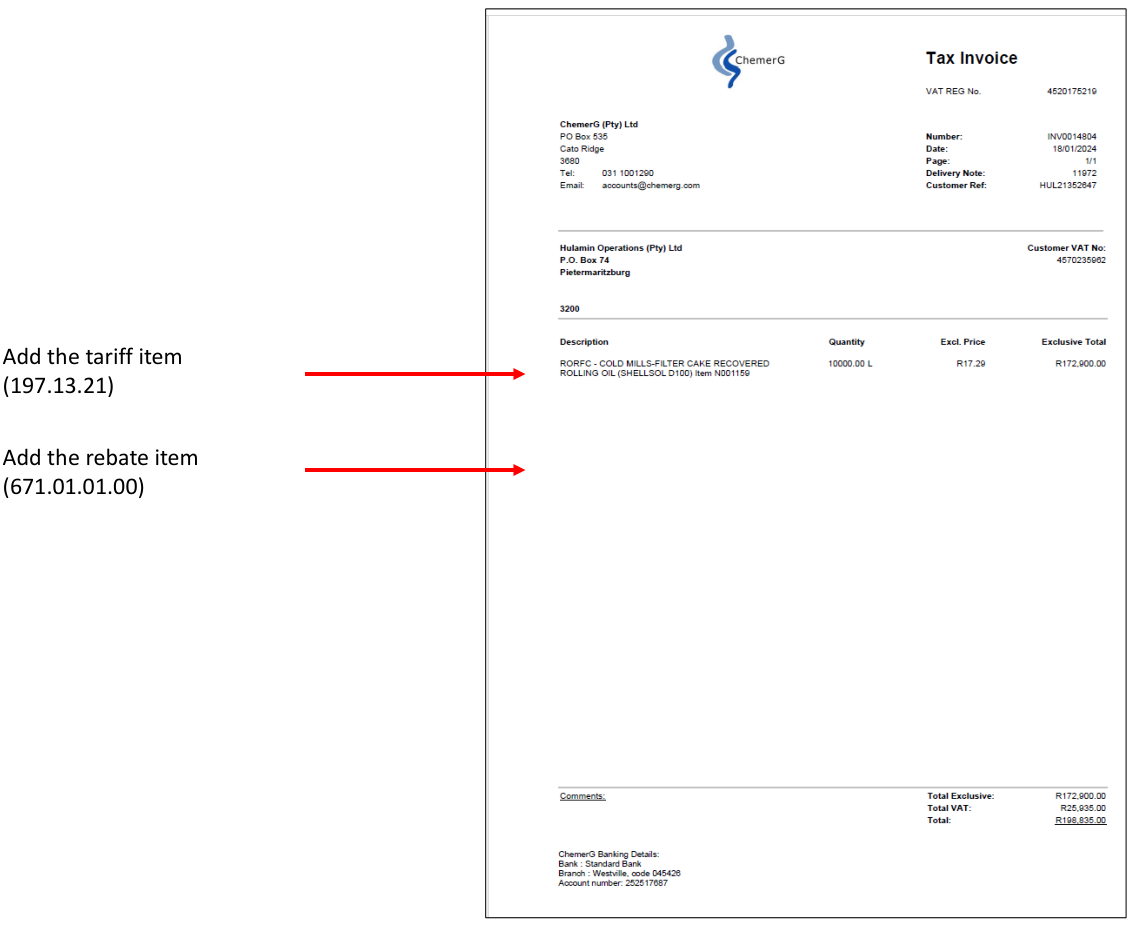
| Invoice | Invoices for removal. The requirements of a supplier's invoice are prescribed in Section 41 together with the relevant Rules. |
| Delivery note / Proof of delivery | A proof of delivery signed by the consignor indicating the volume received. |
Content of delivery note / invoice
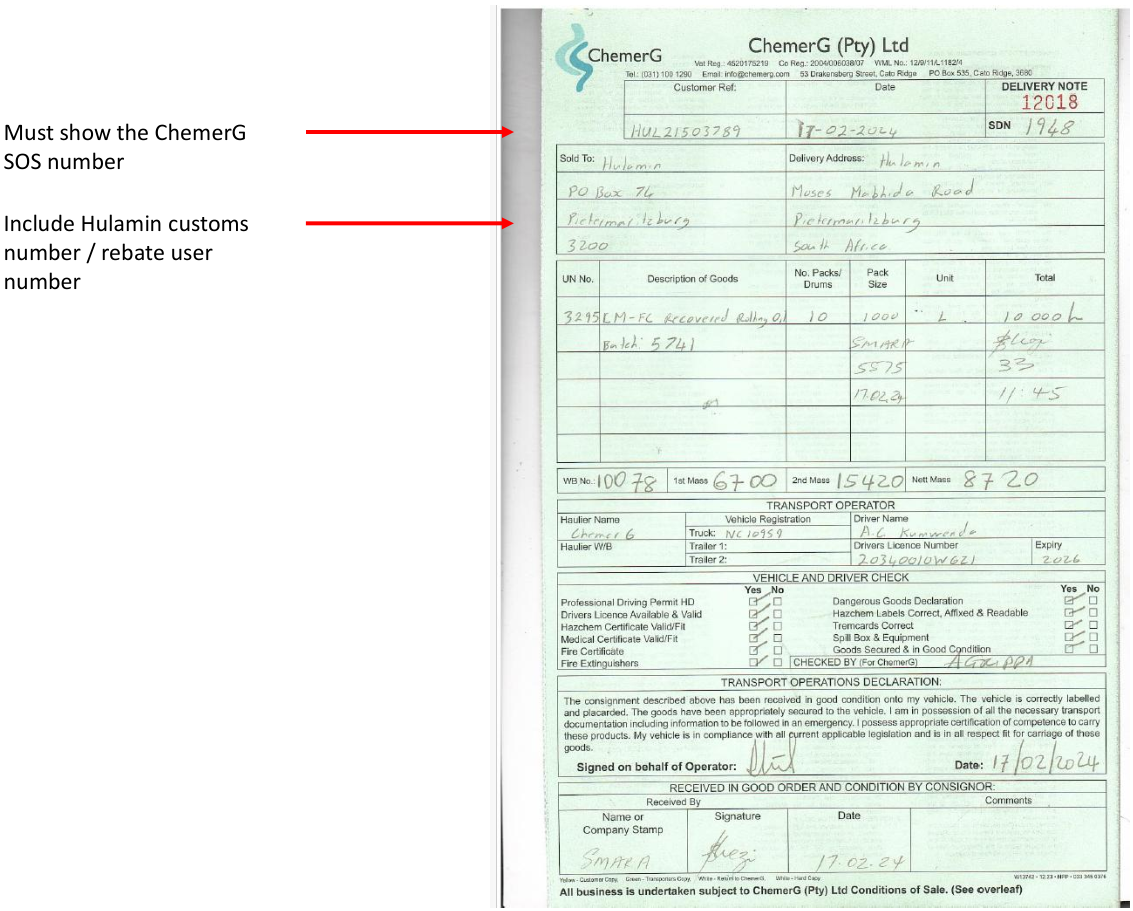
Removal of goods from the ChemerG licensed warehouses must be supported by an invoice or delivery note that must:
- Be numbered and dated.
- Contain the customs client number and VM warehouse number as well as the physical address of the licensee.
- SARS must be able to determine the tariff and potential duty / excise value of the goods.
- Therefore, these documents should include:
- a description and tariff item for the goods.
- the rebate item (if applicable).
- for fuel levy goods, the volume at 20° Celsius.
- the date of removal.
- The name and address of the person to whom the goods are removed.
- The number of the customs and excise warehouse to which the goods are removed (if applicable).
- Where applicable, the price charged for each unit and the total price of the invoice goods (this will be on the invoice).
- Where the goods are removed to a destination in South Africa for any purpose other than home consumption, the customs client number of the person to whom the goods are so removed.
Delivery note template
Invoice template
SAD 500 (ZIB)
SAD 505
Customs Release
Worksheet
Keeping of records
ChemerG should maintain the following records
- Keep books and records detailing stock movements of the unmarked specified AHS.
- All invoices for unmarked specified AHS supplied to any registered solvent user.
- All delivery notes for unmarked specified AHS supplied to any registered solvent user.
- Sub-schedules to the excise accounts for each period.
- ChemerG can keep electronic records if they can be readily converted into hard (paper) copies and made available to SARS when required/requested.
- The retention period for all Excise related documents (prescribed Customs and Excise documents as well as relevant trader’s commercial and financial records) is five (5) years, subject to the provisions of Rule 60.08(2)(a)(i).
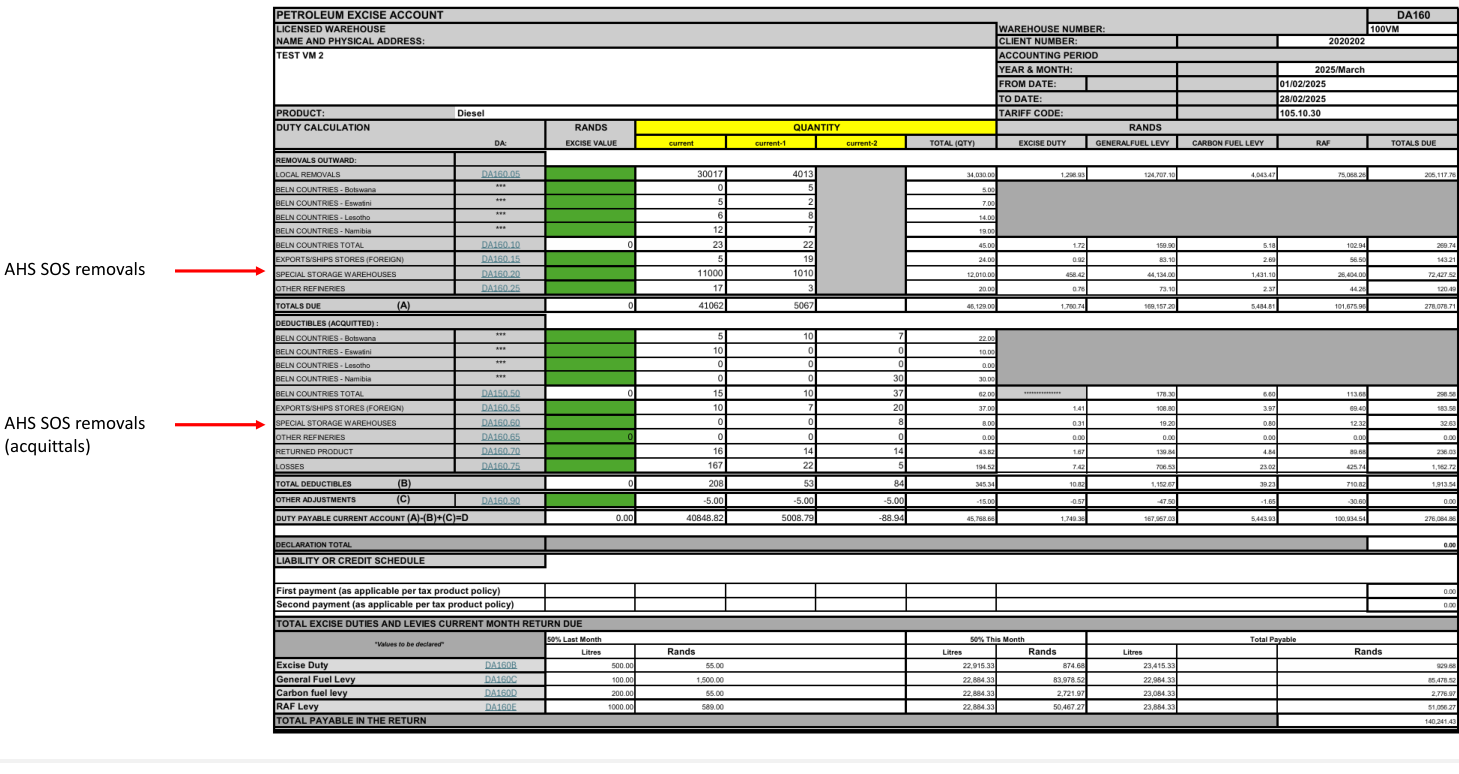
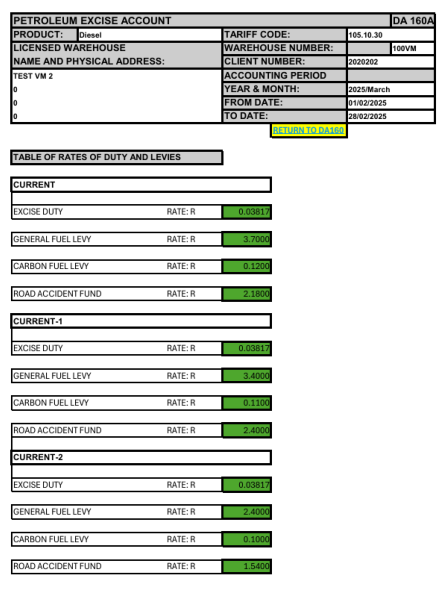
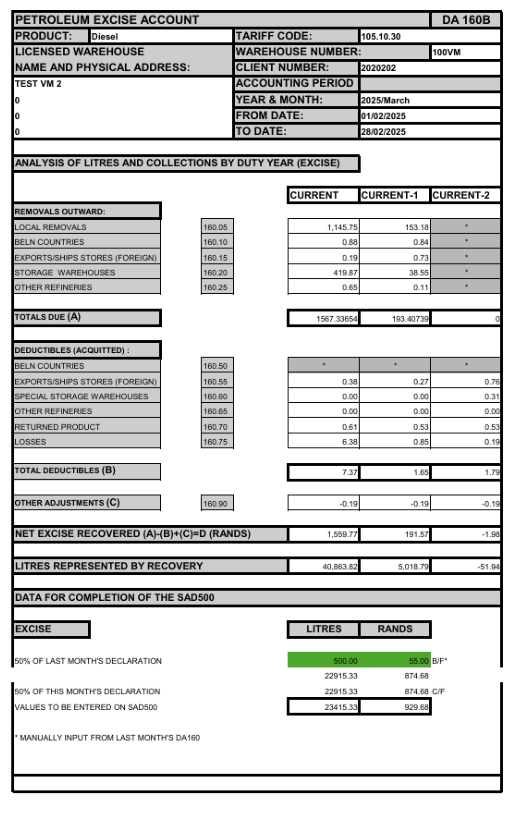
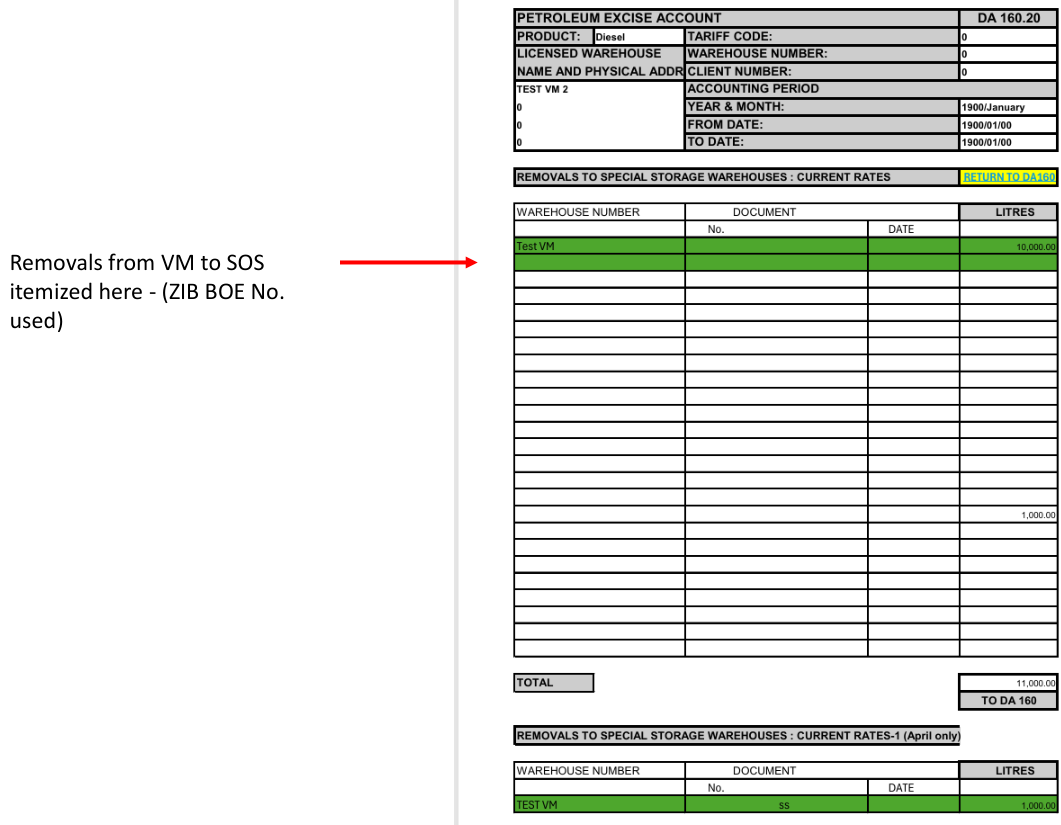
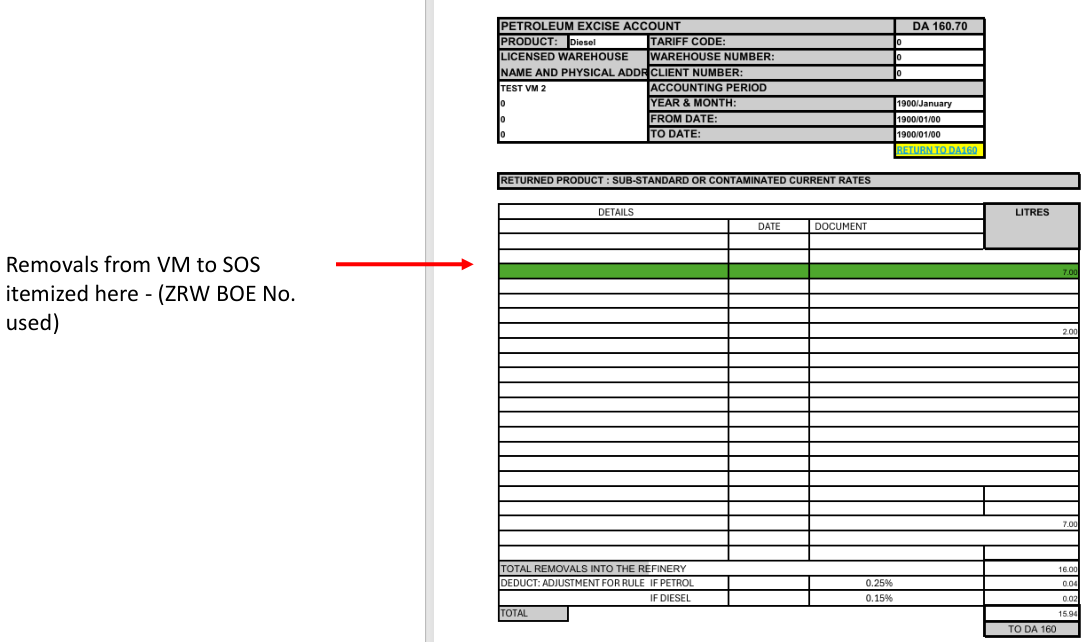
DA 160 (VM) Monthly account
The form required to bring the Excise duty, fuel levy and Road Accident Fund (RAF) levy to account.
The DA 160 is essentially a reconciliation of stock movements in the VM and all values contained in the stock reconciliation are expressed in liters.
The DA 160 is an Excel spreadsheet linked to supporting spreadsheets by formulae and calculations. This package is a linked Excel worksheet comprising lead and supporting schedules.
If the levy rates (fuel levy and RAF) that apply to any transactions brought to account are different to the current rates (for example in the quarter including April each year when rate changes occur, or where earlier year acquittals are brought to account) a separate DA 160 and supporting schedules must be prepared for each rate of levy.
Current rate levy appear on schedules with Suffix “A” previous year’s rate(s) (Current – 1) with the suffix “B”, the year before that (Current – 2) generally with the suffix “C”.
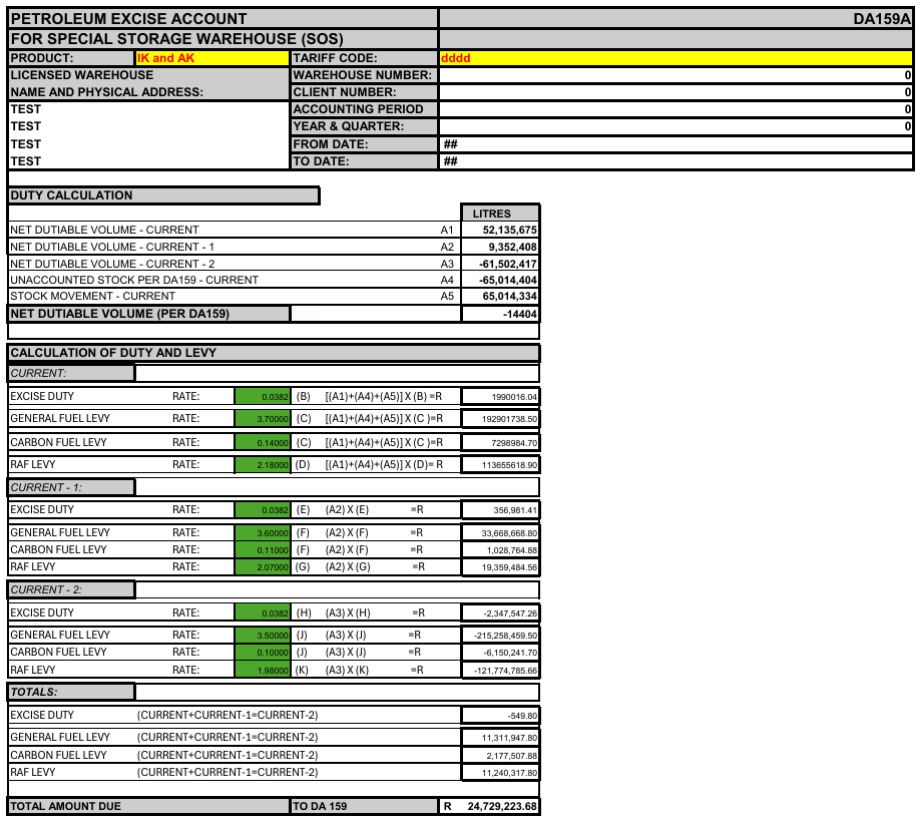
DA 159 (SOS) Quarterly account
The form required to bring the Excise duty, fuel levy and Road Accident Fund (RAF) levy to account.
The DA 159 is essentially a reconciliation of stock movements in the SOS and all values contained in the stock reconciliation are expressed in liters.
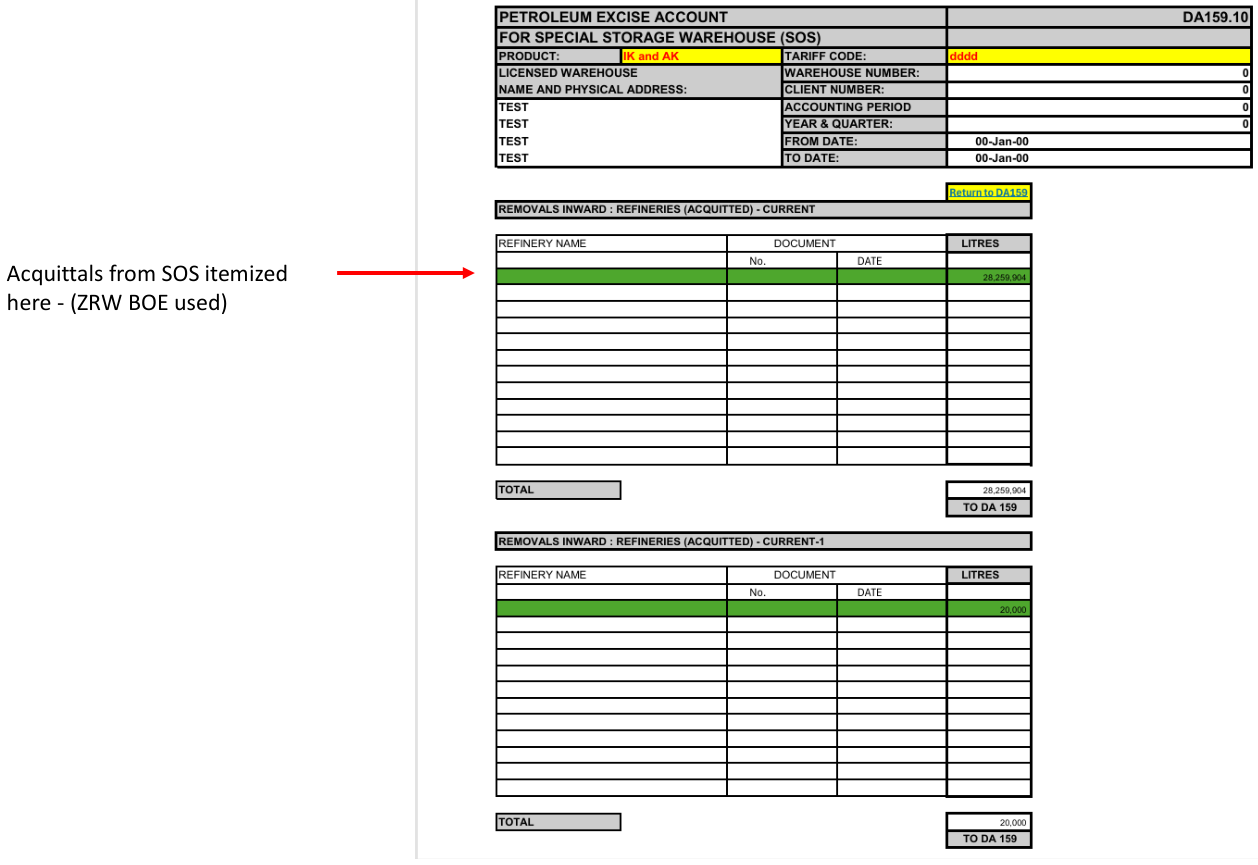
The DA 159 is an Excel spreadsheet linked to supporting spreadsheets by formulae and calculations. This package is a linked Excel worksheet comprising lead and supporting schedules.
If the levy rates (fuel levy and RAF) that apply to any transactions brought to account are different to the current rates (for example in the quarter including April each year when rate changes occur, or where earlier year acquittals are brought to account) a separate DA 159 and supporting schedules must be prepared for each rate of levy.
Current rate levy appear on schedules with Suffix “A” previous year’s rate(s) (Current – 1) with the suffix “B”, the year before that (Current – 2) generally with the suffix “C”.
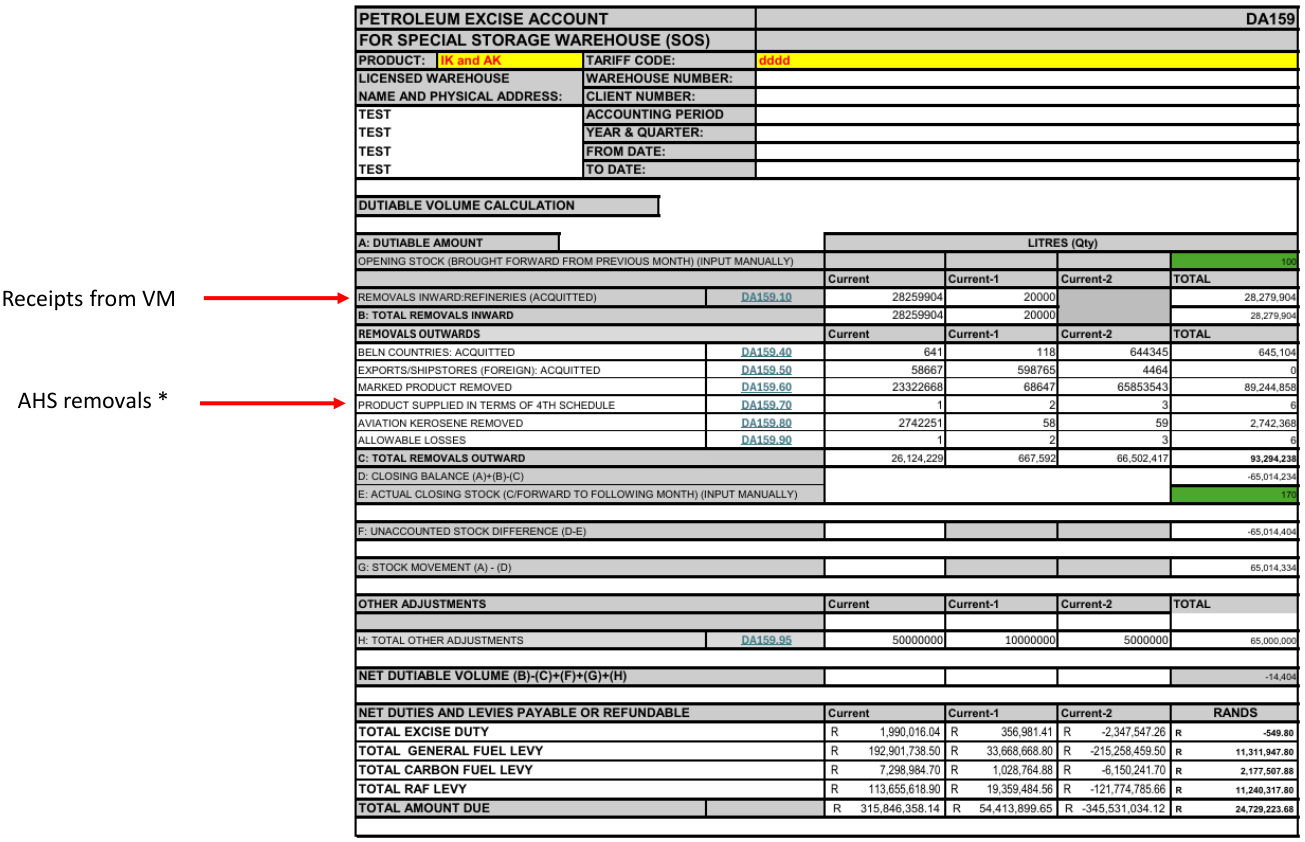
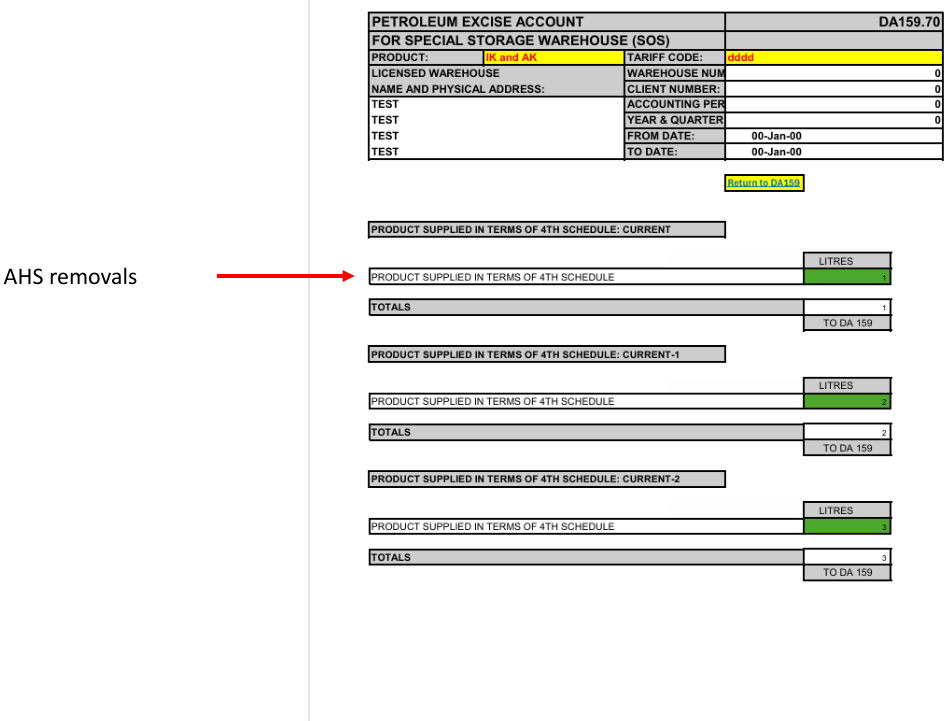
- At the time of preparation of this document, SARS was in process of amending the DA159 to include product supplied in terms of Schedule 6 (also using the DA159.70 sub- schedule)